Articles & Resources
15 Year-End Review Questions That Actually Change Next Year
15 year-end review questions organized into a method — look back, look honestly, look forward — that turns reflection into three real commitments for next year.
Every December, the internet fills with year-end review questions — forty of them, fifty of them, in cheerful lists. And every January, most people who answered them have forgotten the answers. The problem isn't the questions. It's that a list of questions, answered in one sitting and never revisited, is entertainment. A review — one that actually changes the year ahead — is a process: gather the evidence, look back honestly, and leave with a small number of real commitments.
Here's the process, and the fifteen questions I use, in three movements.
Why Most Year-End Reviews Change Nothing
Organizational psychologist Tasha Eurich spent years studying self-awareness, and her central finding is uncomfortable: roughly 95 percent of people believe they are self-aware, but only about 10 to 15 percent actually are. We are all unreliable narrators of our own year. We remember the dramatic weeks and forget the ordinary patterns — and it's the ordinary patterns, repeated fifty-two times, that actually made the year what it was.
That's why this review starts with evidence, not impressions.
Before the Questions: Gather the Evidence
Spend twenty minutes collecting the raw material of your year:
- Your calendar. Scroll it month by month. Where did your time actually go?
- Your photos. They remember what you valued enough to capture.
- Your bank and card statements. Money is a diary. Where did it go, and does that match what you say matters?
- Your messages and milestones. The wins you forgot by March. The hard weeks you survived and minimized.
Now the questions — and answer them in writing. Thinking about a question gives you a feeling; writing the answer gives you the truth.
Look Back: The Year That Was
- What am I most proud of this year — and what specifically did I do to make it happen? Pride with a cause attached becomes a strategy you can repeat.
- What were the three hardest moments, and how did I get through them? You've survived every one of your worst days. Name the resources you actually used — people, habits, help you asked for.
- Where did my time go, compared to where I intended it to go? Hold the calendar up against your stated priorities. The gap between them is the most useful information in this entire review.
- Where did my money go — and would I choose that again? Not with judgment. With curiosity. Money spent on what you value is a success, wherever it went.
- Who were the people this year? Who gave you energy, who drained it, who showed up, who did you show up for? Relationships are the compound interest of a life.
Look Honestly: Lessons, Energy, and Cost
- What did this year teach me that I didn't know in January? If nothing comes to mind, that's an answer too — and not a kind one.
- What drained me repeatedly — and why did I keep allowing it? One hard week is life. The same drain in March, July, and October is a decision.
- What did I avoid, postpone, or pretend not to know? The conversation, the appointment, the application, the apology. Avoidance compounds faster than almost anything else.
- What did I do this year that I'd never done before? Growth leaves evidence. If the list is short, next year needs more firsts — small ones count.
- Which of my habits served me, and which quietly worked against me? You don't need a new personality. You need to know which two or three routines are carrying you and which are costing you.
Look Forward: Setting Up Next Year
- If next year could only be about three things, what would they be? Three. Not twelve. A year with three real priorities beats a year with a dozen intentions.
- What do I want to continue, start, and stop? The simplest planning framework there is — and the "stop" answer matters most, because every new commitment needs time taken from somewhere.
- What would make next December's review easy to write proudly? Describe the year as if you're already reading about it. Specific scenes, not adjectives.
- What's the first small step for each priority — the one I can take in January, in a single week? Goals fail at the starting line far more often than at the finish. Shrink the first step until it's almost embarrassingly doable.
- Who needs to know? A commitment spoken to one trusted person survives February far more often than one kept private. Choose the person before you need the accountability.
Leave With Three Commitments and One Release
When you've answered all fifteen, do the step most reviews skip: distill. Choose three commitments for next year — concrete, in your control, small enough to start and big enough to matter. Then choose one release: a grudge, a goal that was never really yours, a standard you perform for other people. Carrying less into January is worth as much as resolving more.
Finally, make it a ritual instead of an event. Use the same fifteen questions next year. The first year gives you a snapshot; the second gives you a trend, and trends are where the honest insights live — in what changed, and in what stubbornly didn't.
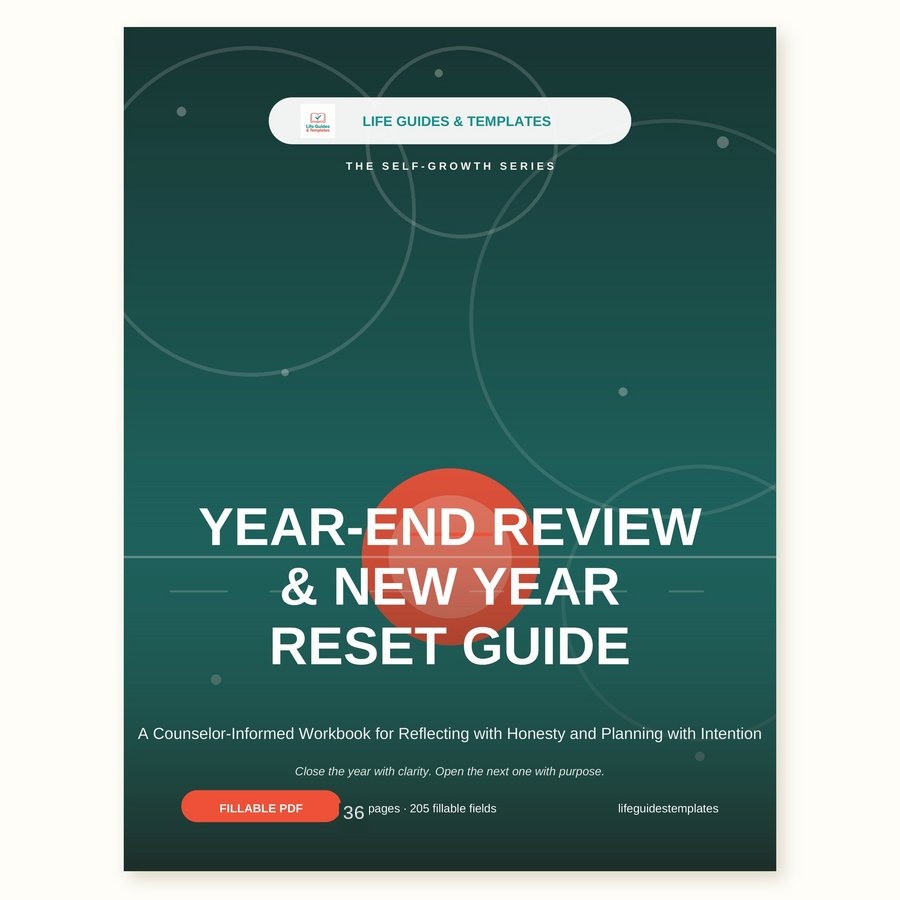
If you'd like a guided workbook version of this process — the evidence-gathering, the questions, and space to build next year's plan — the Year-End Review & New Year Reset walks you through it in fillable pages. And if small daily practices help you stay on course, my Daily Life Tips email brings one practical idea to your inbox each morning — you can sign up on the homepage.
The matching guide
Year-End Review & New Year Reset
A counselor-informed workbook for reviewing your year honestly and designing the next one with goals that actually stick.
About the Author
Kevin P. Bilder, M.Ed., brings 25+ years of leadership in higher education. He holds a master's degree in Educational Leadership from Northern Arizona University. As the creator of Life Guides & Templates, he designs practical, research-informed tools that help people bring more clarity, confidence, and connection into their everyday lives.